
How to Cite
Abstract
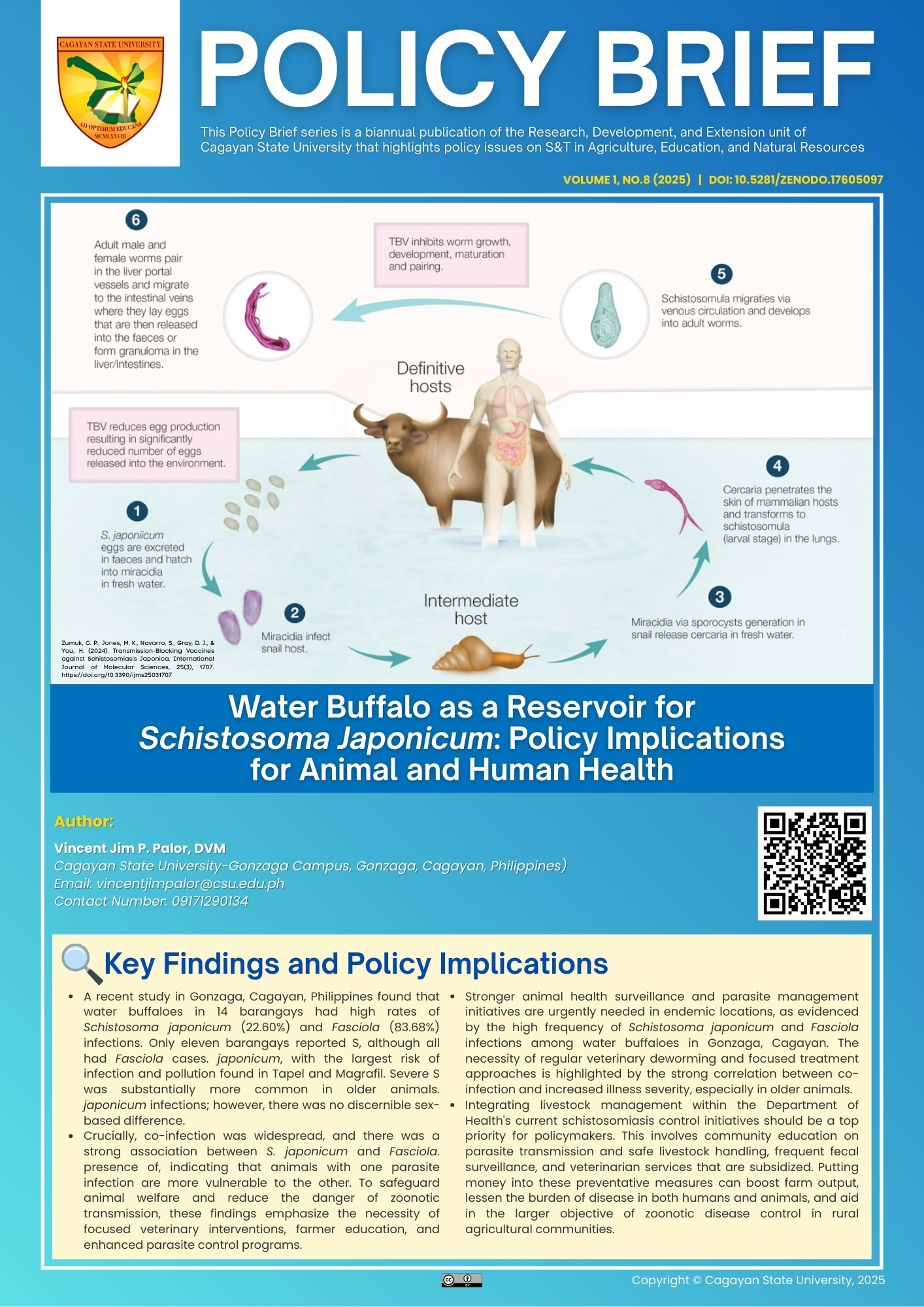
In the Philippines, schistosomiasis is still a major agricultural and public health issue, especially in rural areas where livestock are essential to farming. Humans and animals can contract the parasite trematode Schistosoma japonicum by coming into touch with water sources that are home to infected snails. Carabaos, also known as water buffaloes, are frequently employed in rice cultivation and are important reservoir hosts that support the parasite's ongoing spread. Because of the possible effects on both animal productivity and public health, local stakeholders in Gonzaga, Cagayan, are concerned about reports of probable illnesses in carabaos. Water buffaloes are especially susceptible to parasite illnesses, such as S, because to their wallowing nature and ongoing contact with rice paddies and irrigation canals. Fasciola and japonicum. Designing efficient control strategies for water buffaloes requires an understanding of the prevalence and risk factors of these illnesses. The purpose of this study was to determine the degree of Schistosoma japonicum infection in water buffaloes in a few Gonzaga barangays and to look for potential correlations with age, sex, and co-infection with Fasciola. In order to lower infection risks, protect animal welfare, and slow the spread of zoonotic illnesses in the area, the findings are meant to serve as a guide for local farmers, veterinarians, and legislators as they adopt focused interventions.

This work is licensed under a Creative Commons Attribution 4.0 International License.
Copyright (c) 2025 Policy Brief