How to Cite
Abstract
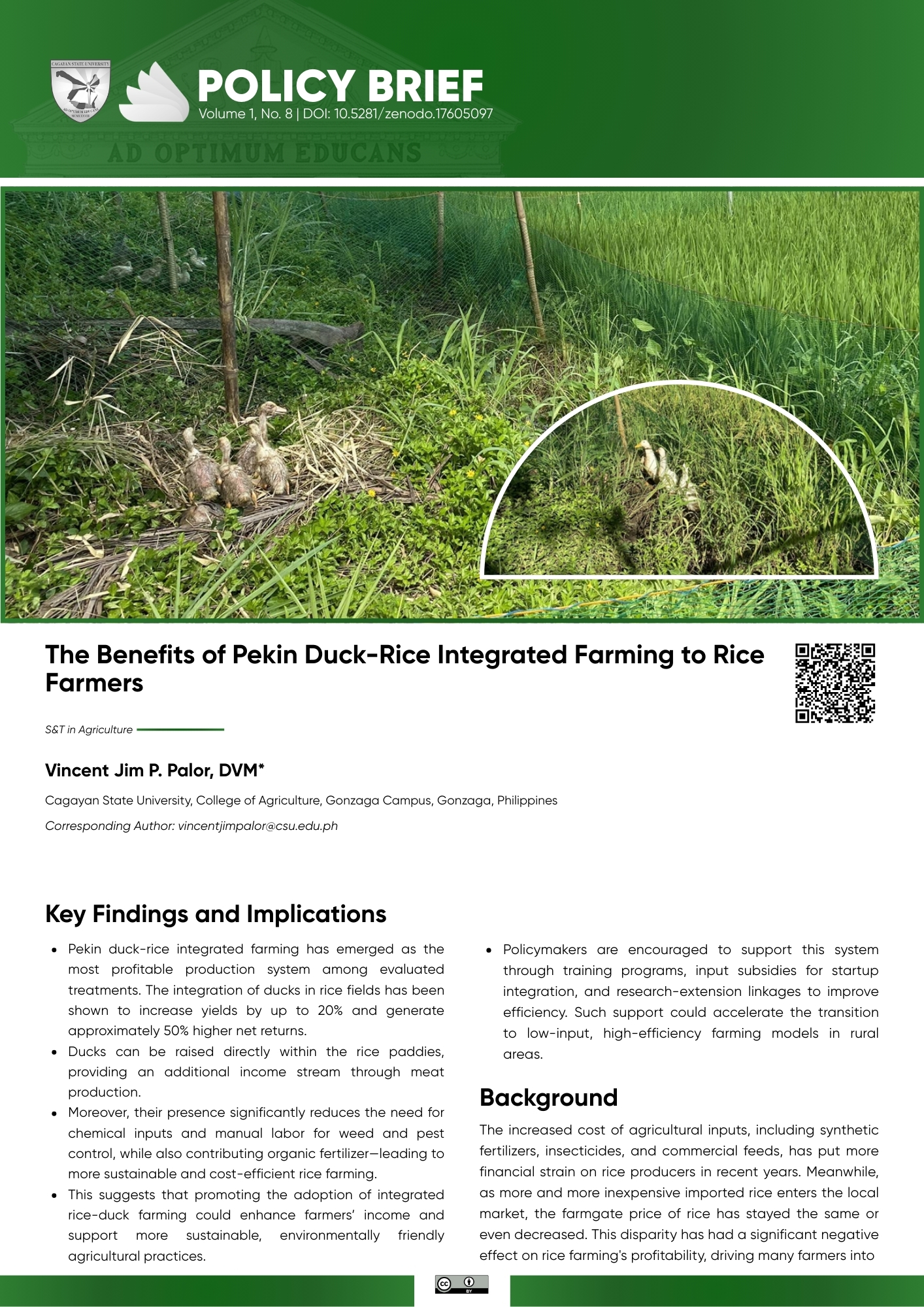
The increased cost of agricultural inputs, including synthetic fertilizers, insecticides, and commercial feeds, has put more financial strain on rice producers in recent years. Meanwhile, as more and more inexpensive imported rice enters the local market, the farmgate price of rice has stayed the same or even decreased. This disparity has had a significant negative effect on rice farming's profitability, driving many farmers into debt and some to give up farming entirely in pursuit of other sources of income.
Cost-cutting measures that can replace or reduce the use of pricey inputs are desperately needed to preserve sustainable rice production and maintain viable incomes. The rice-duck integrated farming system, a traditional, natural method used in other nations, is one promising strategy that provides a workable and affordable substitute. Farmers can diversify their revenue streams and lessen their need for artificial inputs by introducing ducks into rice fields. In order to promote broader adoption among rice producers, this study attempts to illustrate the financial and ecological advantages of rice-duck integration.

This work is licensed under a Creative Commons Attribution 4.0 International License.
Copyright (c) 2025 Policy Brief